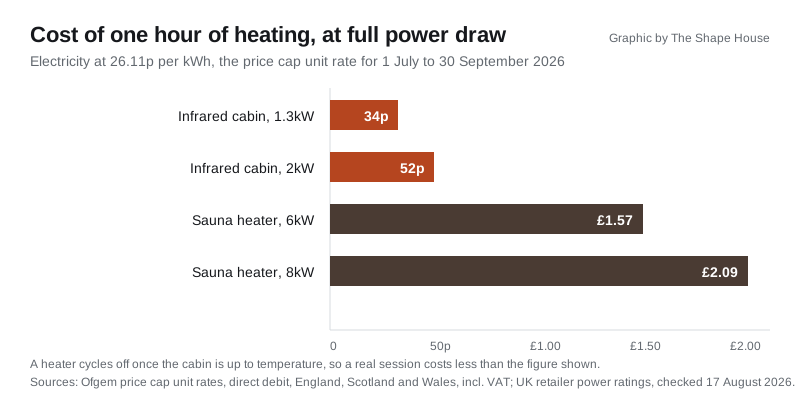
One heats the air to 80-100°C, the other warms your skin at 45-60°C. What that changes: the bill (53p vs £1.58 an hour), the wiring, and the evidence.
Infrared vs traditional sauna
The two are not competing versions of the same thing. A traditional sauna heats the air and you sit in it. An infrared cabin barely heats the air at all and warms your skin directly.
That one difference sets everything else: the temperature, the electricity bill, the wiring you need, and how strong the evidence is for each.
The difference between an infrared and a traditional sauna
A traditional sauna heats the air to 80°C to 100°C and the air heats you. An infrared sauna runs at about 45°C to 60°C, and its emitters warm your skin directly. Everything else follows from that:
- Running cost. An infrared cabin is roughly a third to a quarter of the electricity. About 53p an hour against about £1.58, on the figures below.
- Installation. Most one and two person infrared cabins run off a normal 13A socket. A traditional heater almost always needs a new circuit and a qualified electrician.
- Evidence. The long-term health research is on traditional Finnish saunas. There is no infrared equivalent at that scale.
- Experience. Traditional is hot and short. Infrared is mild and long. Neither is the better one in the abstract.
How each one heats you
A traditional Finnish sauna runs at 80°C to 100°C with relative humidity of 10% to 20%, and sessions of 5 to 20 minutes. Those are the conditions used across the clinical literature, as summarised in a 2018 systematic review of dry sauna bathing. Throwing water on the stones lifts the humidity in bursts.
An infrared cabin runs far cooler, typically 45°C to 60°C. The heat comes from emitters rather than from the air, so you can sit in it much longer before it becomes uncomfortable.
About the “penetrates 1.5 inches” claim
You will see it on a lot of sauna listings. It does not survive contact with the physics.
The German Federal Office for Radiation Protection sets out the actual penetration depths:
- IR-A, 780 to 1,400 nanometres, penetrates up to about 5mm and can reach the hypodermis
- IR-B, 1,400 to 3,000 nanometres, is absorbed in the epidermis
- IR-C, 3,000 nanometres to 1mm, is also absorbed in the epidermis
Far infrared, the type most cabins are sold on, is IR-C. It is absorbed in the outer layer of skin. Millimetres at most, not inches.
That does not make infrared useless. It makes it a comfortable way to raise your core temperature. It is the sweat and the heat load that do the work, not deep tissue penetration.
Side by side
| Traditional Finnish | Infrared cabin | |
|---|---|---|
| Air temperature | 80°C to 100°C | about 45°C to 60°C |
| Humidity | 10% to 20%, higher in bursts | dry, no steam |
| Typical session | 5 to 20 minutes | longer, because it is cooler |
| Warm-up | heats air and stones first | little to warm, so close to on demand |
| Home power draw | 6kW to 8kW heater | 1.2kW to 2kW for one person |
| One hour at full draw | £1.58 to £2.11 | 34p to 53p |
| Electrical supply | new dedicated circuit, notifiable | 13A plug |
| Long-term cohort evidence | yes, on Finnish men | no equivalent |
What each costs to run
The current price cap unit rate is 26.32p per kWh for direct debit customers in England, Scotland and Wales. That covers 1 October to 31 December 2026, and there is no VAT on household electricity from 1 October 2026 to 31 March 2027, so it is the whole price (Ofgem’s rate table). The rate changes every quarter, so check it before you rely on the numbers below.
One hour at full power draw, at that rate:
- 1.3kW infrared cabin: 34p
- 2kW infrared cabin: 53p
- 6kW sauna heater: £1.58
- 8kW sauna heater: £2.11
Those are ceilings, not typical bills. A heater cycles off once the cabin reaches temperature, so a real session lands under the figure. The gap between the two formats stays about the same either way.
The power ratings are real. UK listings for one person infrared cabins run from 1,200W to 2,000W at 230V, checked 17 August 2026. Domestic traditional heaters cluster at 6kW for a small two or three person cabin and 8kW upwards for family sizes.
What it takes to install one
This is where the two really separate, and it is the part most comparisons skip.
A UK 13A socket at 230V tops out at just under 3kW. Every one person infrared cabin in the listings above sits below that, which is why they are sold as plug in.
A 6kW heater is double what a socket can carry. It needs its own circuit, and the rules are specific. Under Part P of the Building Regulations in England and Wales, a room containing a sauna heater is a special location. The IET’s Part P guidance confirms that installing a new circuit is notifiable work, and that additions to existing circuits in a special location are notifiable too.
In practice that means a registered electrician and a certificate. Budget for it before you budget for the cabin.
What you will pay for the cabin
Prices checked 17 August 2026. Treat them as the shape of the market rather than a quote.
- Infrared cabins: one person models from about £1,234, and a UK retailer range spanning £1,389 to £7,899 across 11 models for one to three people.
- Traditional indoor build: Finnmark puts materials for a 2m by 2m room at £1,500 to £4,000, with domestic heaters at £400 to £1,800 on top, plus the electrical work.
- Traditional outdoor cabin: £10,000 to £19,000 and up, on the same source.
The archived version of this page quoted £8,000 to £25,000 for traditional and £2,000 to £8,000 for infrared. The infrared range was roughly right and the traditional range was not, at least for an indoor room.
What the evidence shows
The strongest finding comes from the Kuopio Ischaemic Heart Disease Risk Factor Study. Laukkanen and colleagues followed 2,315 middle-aged Finnish men for a median of 20.7 years and published the results in JAMA Internal Medicine in 2015. Compared with men who used a sauna once a week:
- 2 to 3 sessions a week was associated with 22% lower risk of sudden cardiac death
- 4 to 7 sessions a week was associated with 63% lower risk
Read those numbers carefully. It is an observational cohort, so it shows association and not cause. The participants were Finnish men aged 42 to 60. And they were using traditional saunas, not infrared cabins.
The broader picture is similar. A 2018 systematic review covering 40 studies and 3,855 participants found benefits reported across cardiovascular, respiratory and pain conditions, with one reversible adverse effect. Again, dry sauna.
Infrared has its own clinical trials, mostly small and condition-specific. It does not have anything resembling a twenty-year cohort. If long-term cardiovascular evidence is your reason for buying, that evidence is on the traditional side.
What the evidence does not show
Two claims are on almost every sauna sales page, including the old version of this one. Neither holds up.
Detox. Sweating is not a meaningful route for clearing toxins. The liver and kidneys do that work. Jari Laukkanen, the author of the cohort study above, has said plainly that it is not known whether sauna bathing helps get rid of toxins, because the liver and kidneys usually remove more than the sweat glands do. On the same review, Pascal Imbeault of the University of Ottawa put the quantities in perspective: two litres of sweat would carry less than one tenth of a nanogram of the pollutants concerned. A 2019 review concluded that direct evidence for sweating as an effective detoxification method is lacking.
Weight loss. What you lose in a session is water, and you replace it when you drink. We have dropped the weight-loss and calorie-burn claims that the old page carried, because we cannot support them.
Safety
The radiation protection guidance for infrared cabins is short and worth following. From the BfS:
- get medical advice first if you are cardiovascularly sensitive
- stop using it if you get prolonged reddening of the skin
- do not use a cabin under the influence of alcohol, drugs or medication that dulls pain
- the eyes are particularly sensitive to heat, and goggles protect them
The reason the alcohol rule matters: your protective reflex is pain, and anything that blunts pain removes the signal that tells you to get out.
Which one to buy
Pick a traditional sauna if you want the real thing, you have the space and the budget for the electrical work, you like intense short sessions, and you want the format the long-term research was done on.
Pick an infrared cabin if you want to plug it in and use it, you are heat sensitive, you want to sit in it for half an hour with a book, or you want a third of the running cost.
If you are recreating the studio experience at home rather than building a Finnish room, our urban sweat lodge guide covers the practical side: space, power and what a session actually involves.
Frequently asked questions
What is the main difference between an infrared sauna and a traditional sauna?
How they heat you. A traditional sauna heats the air to 80°C to 100°C, with 10% to 20% humidity. An infrared cabin leaves the air at about 45°C to 60°C and warms your skin with emitters, so sessions are cooler and longer.
Which is cheaper to run?
Infrared. At the October to December 2026 price cap rate of 26.32p per kWh, a 2kW infrared cabin costs 53p for an hour at full draw and a 6kW sauna heater costs £1.58.
Do I need an electrician for either?
Usually only for a traditional sauna. One person infrared cabins draw 1.2kW to 2kW and plug into a 13A socket. A 6kW heater needs its own circuit, which is notifiable work under Part P in England and Wales.
Does infrared heat reach deeper into the body?
No. Far infrared, the type most cabins are sold on, is absorbed in the outer layer of the skin, according to Germany’s Federal Office for Radiation Protection. The “penetrates 1.5 inches” claim does not hold up.